
Cervical Disc Replacement
What is Cervical Disc Replacement?
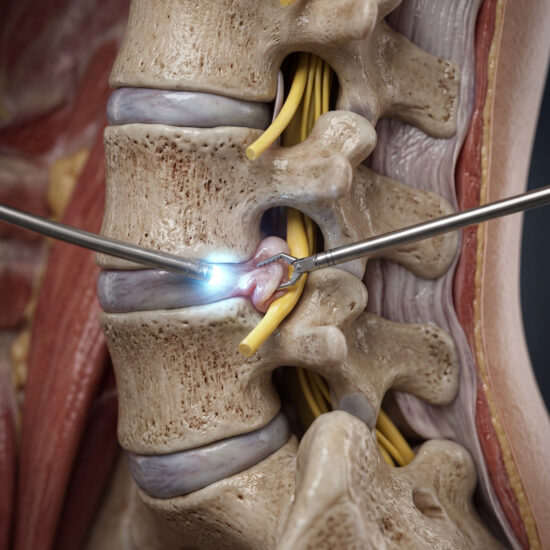 The cervical spine consists of seven vertebrae separated by discs that act as shock absorbers and allow for movement. When a disc becomes damaged, it can cause neck pain and/or nerve compression.
Cervical disc replacement—also known as total disc arthroplasty—is a procedure in which the diseased disc is removed and replaced with an artificial device.
The goals of surgery are to:
- Relieve pressure on the nerves
- Restore disc height
- Preserve motion at the affected level
By maintaining movement, disc replacement may help reduce stress on adjacent segments.
Cervical Discectomy and Fusion (ACDF)
Not all patients are ideal candidates for disc replacement. In some cases, restoring stability is more appropriate than preserving motion.
Anterior cervical discectomy and fusion (ACDF) involves removing the damaged disc, decompressing the nerves, and stabilizing the segment using a fusion device.
The choice between disc replacement and fusion depends on the condition of the disc, facet joints, and overall biomechanics of the spine.
The goal is not to perform a specific procedure, but to select the right operation for the right patient based on the underlying biomechanics and source of symptoms.
Cervical disc replacement is best suited for patients in whom the disc is the primary structure that has failed, while the surrounding joints and stabilizing structures remain intact.
When the facet joints are also degenerated, or when clinical instability suggests a broader structural failure beyond disc-related or nerve-related pain, fusion is often the more appropriate option.
When Fusion May Be More Appropriate
Fusion may be preferred in patients with:
- Advanced facet joint degeneration or arthritis
- Significant disc collapse with loss of motion
- Large osteophytes (bone spurs) and structural changes
- Poor bone quality (e.g., osteoporosis)
- Chronic muscular dysfunction or persistent neck spasms
- Evidence of instability or hypermobility