
Lumbar Laminectomy
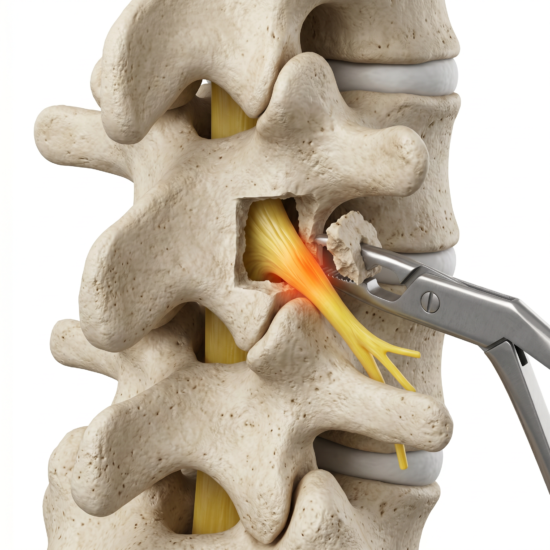 Lumbar laminectomy is a surgical procedure used to treat nerve compression caused by narrowing of the spinal canal (spinal stenosis).
As the space around the nerves becomes restricted, multiple nerve roots may be affected at the same time, leading to symptoms such as leg pain, numbness, weakness, or difficulty walking (neurogenic claudication).
The goal of surgery is to create more space for the nerves and relieve this pressure.
When Is It Indicated?
Lumbar laminectomy is typically indicated when there is central canal stenosis, especially when multiple nerves or levels are involved.
This includes:
- Leg symptoms affecting both sides or multiple nerve distributions
- Difficulty walking or standing due to neurogenic claudication
- Imaging showing narrowing of the central spinal canal
- Failure of appropriate non-operative treatment
Some patients also experience what is often referred to as neurogenic back pain—a pattern where there is little to no pain at rest or when first standing, but increasing back discomfort develops with prolonged standing or walking, and improves with sitting. This reflects nerve-related symptoms rather than true mechanical back pain.
In these cases, the problem is not a single focal compression, but a global narrowing of the canal, which requires a broader decompression.
Why Not Always Use Endoscopy?
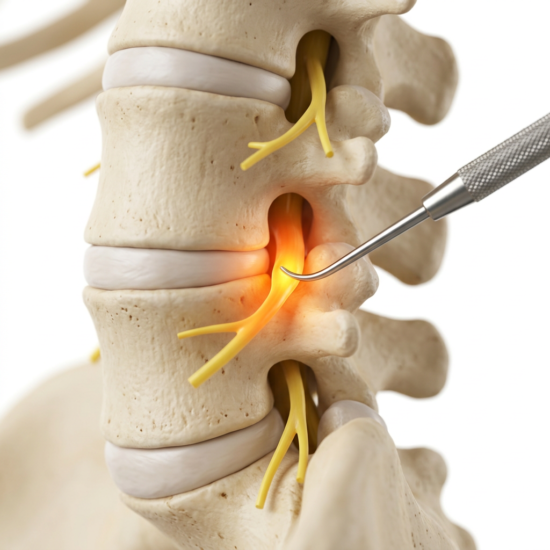 While minimally invasive and endoscopic techniques are preferred when appropriate, they are not suitable for all conditions.
In cases of central stenosis or multi-level disease, endoscopic approaches may become technically complex, prolonged, and less effective. Attempting to limit surgical exposure in these situations can increase the risk of:
- Incomplete decompression
- Persistent symptoms
- Nerve irritation or injury
- Prolonged operative and anesthesia time
- Facet joint instability
There is little benefit in reducing surgical invasiveness if it compromises the completeness or safety of the decompression.
What Does the Procedure Involve?
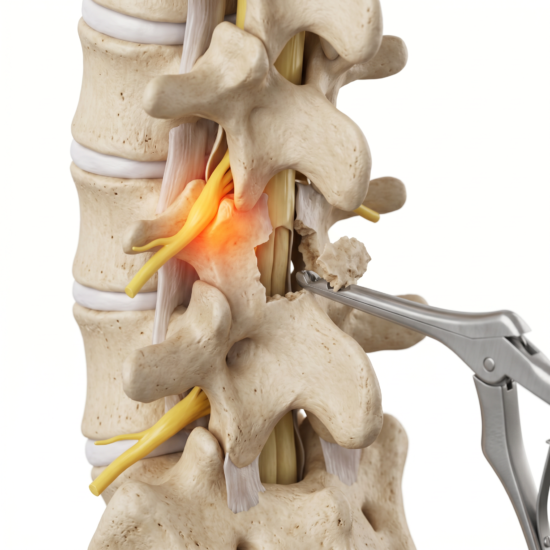 Lumbar laminectomy involves removing a portion of bone and thickened tissue from the back of the spine to enlarge the spinal canal.
This allows the compressed nerves to be fully decompressed. The extent of decompression depends on the number of levels involved and the severity of narrowing.
Whenever possible, the procedure is performed in a way that preserves as much normal structure and stability as possible.
Our Approach
 Our focus is on achieving a complete and durable decompression while preserving spinal stability.
Preoperative assessment is critical in determining whether decompression alone is appropriate. In the majority of cases, patients do very well with laminectomy alone and are unlikely to develop instability, mechanical back pain, or recurrent stenosis.
When the clinical picture is less clear, we often favor a less invasive approach initially. Over-treating with more extensive procedures, such as fusion, is not necessarily better and can introduce additional risks.
At the same time, if symptoms persist or if instability develops over time, further treatment—including fusion—may be considered.
Limitations and Considerations
Lumbar laminectomy is effective for relieving symptoms caused by nerve compression, particularly leg pain and difficulty walking.
It is less effective for isolated mechanical back pain without significant nerve involvement.
More extensive procedures, such as fusion, may reduce the risk of certain problems but also carry their own risks, including adjacent segment degeneration, non-union, and increased perioperative pain.
Balancing these factors requires careful, individualized decision-making based on the patient's symptoms, anatomy, and overall goals.