
Lumbar Fusion
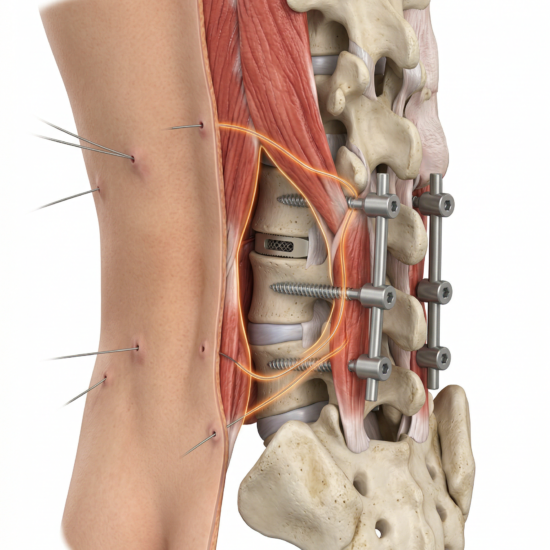 Lumbar fusion is a surgical procedure used to treat conditions where a spinal segment has lost its structural integrity.
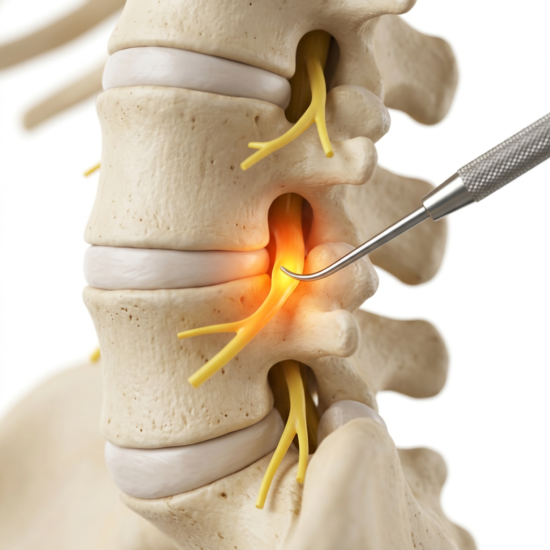
This may involve the disc, the facet joints, or both. When these structures can no longer support normal loads without pain or instability, simply decompressing the nerves may not be sufficient.
In these cases, the goal of surgery is to restore stability and relieve symptoms.
When Is It Indicated?
Lumbar fusion is considered when there is evidence of structural compromise of the spinal segment.
This may include:
- Spondylolisthesis (slippage of one vertebra over another)
- Significant disc degeneration, including broad compromise of the annulus (disc wall), where the disc has lost its ability to function normally
- Advanced facet joint degeneration or incompetence
- Recurrent disc herniation in the setting of poor disc integrity
- Mechanical back pain related to segmental instability
- Adequate bone quality, as osteopenia may influence surgical planning, and advanced osteoporosis may represent a limitation to certain fusion techniques
In these situations, discectomy alone is often not sufficient, as the underlying problem is not just nerve compression, but loss of structural support.
What Does the Procedure Involve?
 Lumbar fusion involves stabilizing a segment of the spine using instrumentation, typically screws and rods, along with placement of a spacer (interbody cage) to restore disc height and alignment.
Restoring disc height and alignment can also provide indirect decompression, relieving pressure on the nerves by opening the spaces through which they pass.
Improving spinal alignment—particularly restoring lumbar lordosis—is an important goal of surgery, as it helps reduce mechanical strain on adjacent spinal levels over time.
Over time, the treated segment heals into a single, stable unit.
Our Approach
 Fusion is recommended when there is clear evidence that the spinal segment cannot function normally without additional support.
We aim to limit fusion to the minimum number of levels required and to combine it with precise decompression when needed. When appropriate, we use percutaneous and minimally invasive techniques to reduce tissue disruption, blood loss, and shorten recovery time.
Our focus is on achieving a stable, well-aligned construct that provides durable symptom relief while minimizing the impact of surgery.
Balancing Benefit and Risk
Fusion can be highly effective when indicated. However, it is a more extensive procedure and carries additional considerations, including:
- Longer recovery time
- Increased stress on adjacent spinal levels over time
- Higher overall complication profile compared to less invasive procedures
Modern techniques have significantly improved outcomes, and with appropriate patient selection and surgical technique, the risk of complications such as non-union can be minimized.
For this reason, fusion is reserved for situations where less invasive options are unlikely to provide a durable or effective result.
Limitations and Considerations
Fusion is not intended to treat all forms of back pain. Its success depends on correctly identifying the segment responsible for symptoms.
In cases where multiple pain generators are present or the diagnosis is unclear, outcomes may be less predictable.
Postoperative rehabilitation and attention to movement patterns remain important to support recovery and protect adjacent segments over time.