
Endoscopic Cervical Foraminotomy
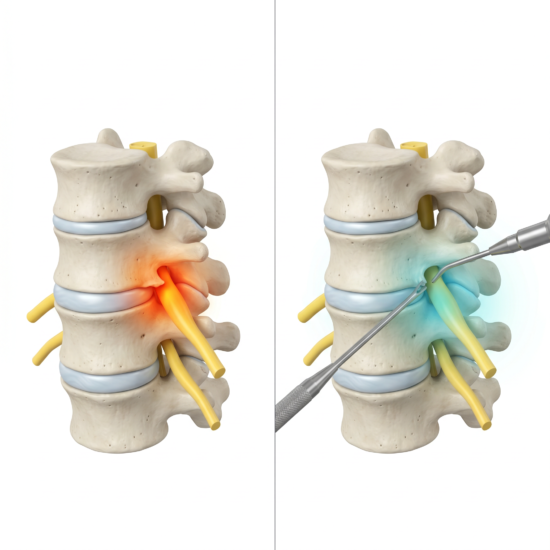 In selected cases, it is possible to treat nerve compression without removing the entire disc or performing a fusion.
When a disc herniation is present but the disc itself retains its structural integrity—and when there is minimal or no discogenic neck pain—the primary issue may be isolated nerve root compression rather than failure of the entire motion segment.
In these situations, an endoscopic cervical foraminotomy can be performed. This minimally invasive procedure involves relieving pressure on the affected nerve by creating space around it, without removing the entire disc or significantly altering the natural biomechanics of the spine.
In some cases, small disc extrusions can be selectively removed to further decompress the nerve, while preserving the remainder of the disc.
The Goal of This Approach
- Decompress the nerve root
- Preserve the native disc and surrounding structures
- Maintain near-normal motion at the affected level
When This Approach May Be Appropriate
 This procedure may be considered in patients presenting with:
- Disc herniation with preserved disc integrity
- Predominantly arm pain (radiculopathy) with minimal neck pain
- No significant facet joint degeneration
- No evidence of instability
Key Concept
Not all disc herniations require disc removal or fusion. In selected patients, treating the nerve compression alone can provide effective relief while preserving near-normal spinal function.